

From Fixed to Fluid: The Practice of Adapting and Becoming
DesignShifters as shapeshifters

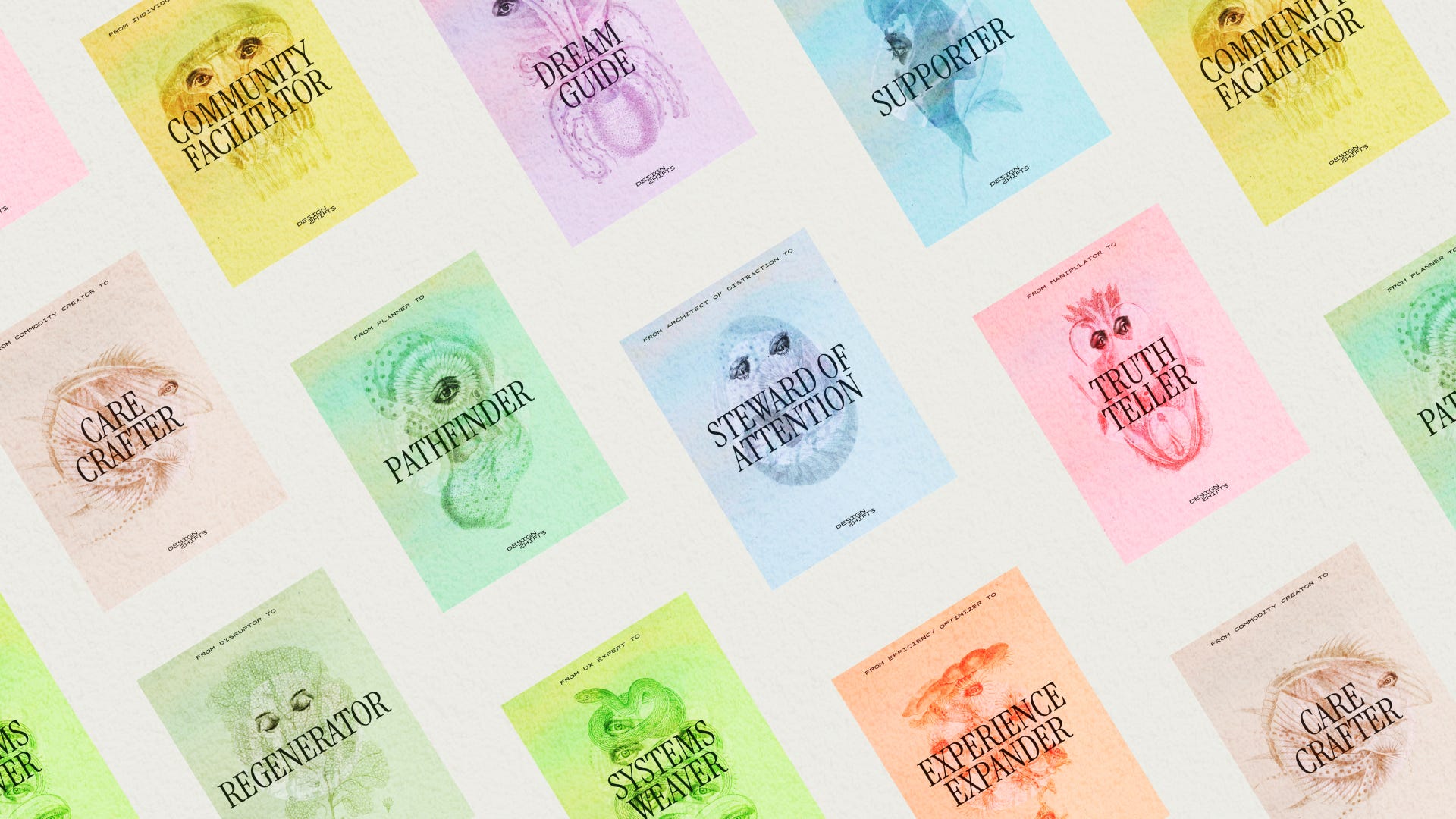
A while back, I created 10 new archetypes for designers: The Regenerator, The Dream Guide, The Community Facilitator, The Systems Weaver, The Truth Teller, The Steward of Attention, The Experience Expander, The Supporter, The Pathfinder, and The Care Crafter. I positioned each as a distinct role—a new way to frame what designers do.
But here’s what I’ve been wrestling with: in naming these archetypes, was I just creating new containers? New ways to be boxed in?
A liberatory future doesn’t need better categories. It needs us to release our grip on fixed identities entirely. I’ve written before about moving from Single Stories to Layered Narratives, and I realize now that that applies to how we think about ourselves. What would it mean to let go of any one way of being or one “role” and instead move fluidly between different lenses depending on the context we find ourselves in?
DesignShifters as Shapeshifters
In mythology, shapeshifters move fluidly between forms, never trapped in a single identity, always adapting to what the moment requires. In folklore, we see foxes becoming birds, the guide becoming the stranger, the healer becoming the warrior. The power of shapeshifters lies not in any single form, but in the grace of transition itself.
DesignShifters embody this same fluidity.
Traditional design roles have taught us to build our identity around what we make: “I’m a UX designer.” “I’m a brand strategist.” “I’m a product designer.” These titles became our containers, and sometimes our cages. We’re rewarded for consistency, for building a personal brand, for specializing. “Pick a lane,” they tell us. “Master one thing.”
But the work itself tells a different story. Every designer knows that our real value lives in the process. How we show up, how we sense what’s needed, how we adapt our approach to the people and problems in front of us makes all the difference. On the surface, we are judged by what we make in the end, but the magic happens in how we respond to the unfolding complexity along the way.
DesignShifters recognize that who we are is less important than how we show up. Our value doesn’t come from defending a single role, but from our capacity to become what the work needs us to be in each moment. This means holding different forms depending on the context and the people around us.
What this looks like in practice
Consider me, Ida, working on a community health initiative.
On Monday, I’m a Systems Weaver, mapping how food access, transportation, and clinic hours intersect to create healthcare barriers. I trace feedback loops, identify leverage points, and see the invisible connections that shape health outcomes.
By Wednesday, community stakeholders arrive for a co-design session. I shift into Community Facilitator, creating structures for equitable participation, ensuring marginalized voices aren’t drowned out by louder stakeholders. I’m no longer the expert mapping systems. I’m the one holding space for collective wisdom to emerge.
Friday brings a presentation to hospital leadership. I become a Truth Teller, naming the uncomfortable reality that their current metrics prioritize efficiency over equity. I present data that challenges assumptions and makes power dynamics visible.
Same designer. Same project. Three different forms, each one essential, each one requiring me to release attachment to a single identity and become what the moment needs.
This takes courage
In a culture that rewards specialization and consistency, choosing to be a shapeshifter takes real courage.
You’ll be told you’re unfocused. That you need to “niche down.” That mastery requires singular commitment. That your LinkedIn profile is confusing. That clients won’t know what to hire you for. I understand this pressure intimately. We’re taught that credibility comes from consistency, that expertise means staying in one lane, that transformation is the same as being flaky or uncommitted.
But here’s the truth: the challenges we face (climate collapse, inequality, democratic erosion) are not single-lane problems. They are tangled, systemic, and constantly shifting. They require designers who can shift with them.
DesignShifters understand that doing work that matters means developing the ability to move gracefully between forms, to hold multiple ways of being without losing ourselves in the transitions. Just as a shapeshifter reads the forest, the weather, the approaching danger, we develop the capacity to sense what a situation calls for and match our approach to the context.
Stepping into a fluid year
As you step into this year, I want to offer you something different than a goal or a word or a theme. I want to offer you permission to remain undefined.
What if, instead of deciding who you are, you practiced noticing how you are shifting?
What if you tracked not what you achieved, but how you responded?
Not what identity you built, but what transitions you navigated?
What if you measured your year not by consistency, but by your capacity to sense and shift
When we’re not locked into one form, one role, one way of being, one title, we become capable of responding to complexity with creativity and care.
We become practitioners who can meet the world as it is, not as we wish it to be. We become the transition activists Arturo Escobar describes in Designs for the Pluriverse, walking hand in hand with those protecting life, redefining wellbeing, and nurturing the futures we need.
I started by creating 10 distinct designer archetypes. Now I understand: the future doesn’t need better categories. It needs people who can shapeshift and become what the moment requires, and then release that form when the moment passes.
That is the practice of the DesignShifter.
That is the way of the shapeshifter.
Thank you for the “permission to remain undefined”, that reverberates deeply for me as I’m struggling to reconcile my diverse interests and abilities with the pressure to niche and specialize. I believe deep down the designer I am and want to be is much more pluralistic and trans-disciplinary. The only challenge really then is finding the partners who value and need this kind of collaboration so that I can sustain my business in this way. Bridging the old paradigm into the new is exciting work, but also daunting when our economics feel so fragile and force us into relative scarcity. I’m practicing letting those impulses and fears flow past me, while I yearn to deepen this practice and attract collaborators and clients.
Happy 1 year anniversary of an amazing Substack 🌱 love swimming alongside and seeing the moves you make.