

7 DesignShifts Dimensions
An in-progress framework for areas of shifting

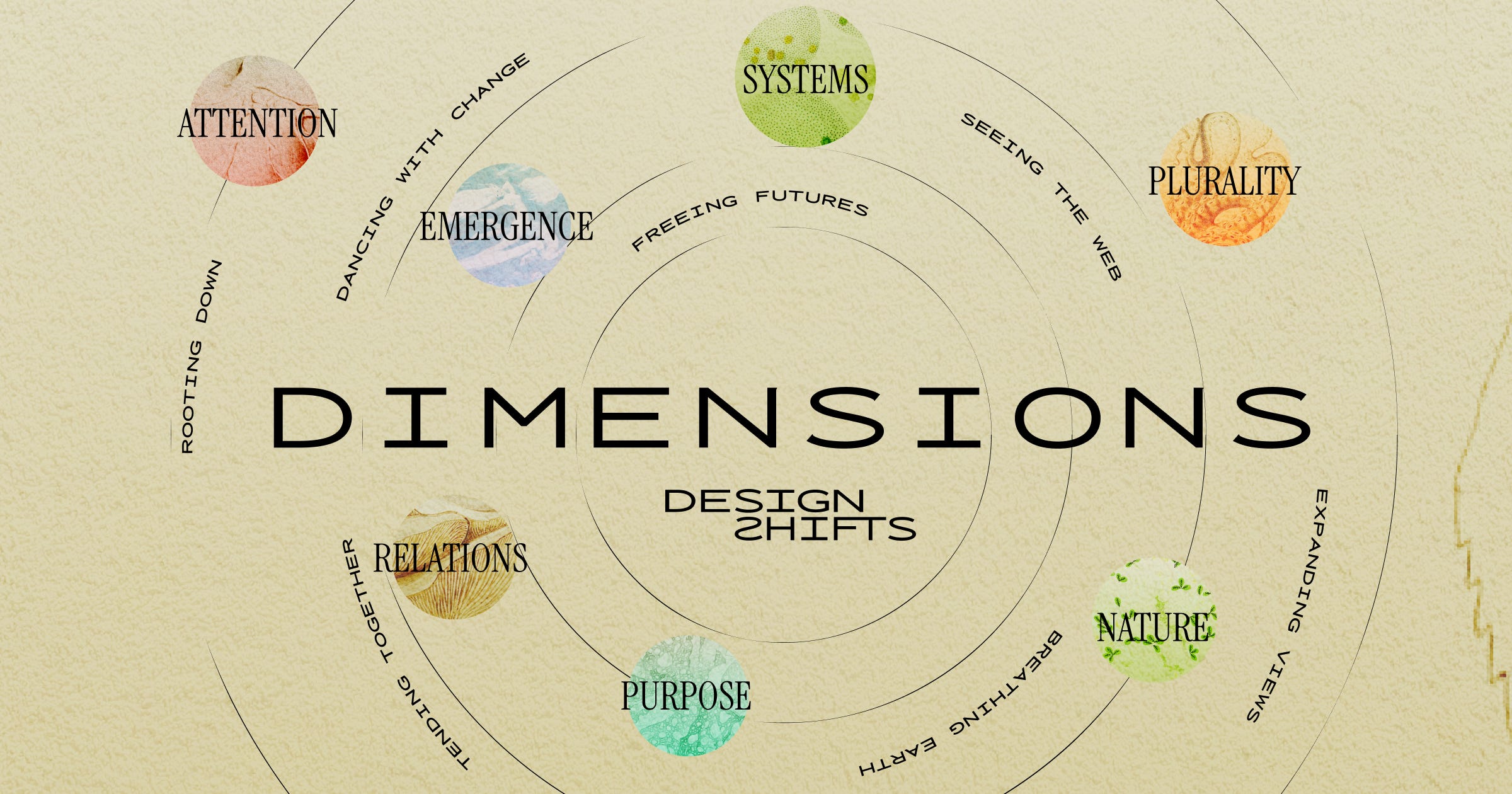
Over the past few years, I’ve been working through a lot of interconnected questions about design: what it’s for, who it serves, what it keeps getting wrong, and what it could become. At some point, patterns started emerging from the research, the projects, the conversations, and the failures. I’ve started to see patterns and overarching themes that I’m calling the Seven DesignShifts Dimensions.
This post invites you to interact with these categories as a frame for how design can meaningfully respond to social, ecological, and systemic challenges. These dimensions address design’s current misalignments: in attention, complexity, systems-thinking, power, our relationship and cooperation with each other and the living world, and ultimate purpose. Practicing them together creates a map of where we might shift toward slower, more rooted, humble, and regenerative design.
7 DesignShift Dimensions of Transformation
Awareness and Attention
Emergence
Systems
Plurality and Power
Nature
Relations
Purpose
1. Awareness and Attention : Rooting Down
Asks you to slow down and pay attention. Invites you to examine how we perceive, where we direct attention, and how we help others see and choose differently.
Core question: What is grabbing our attention and how do we learn to pay attention?
We live in an age of manufactured distraction. Design has become complicit in fragmenting our attention, optimizing for engagement over meaning, and accelerating us beyond our capacity to metabolize experience. The attention economy treats human consciousness as a resource to extract rather than something sacred to protect.
But the crisis isn’t just about distraction; it’s about disconnection from meaning itself. When design prioritizes speed over slowness, novelty over depth, and metrics over mattering, we lose our ability to discern what’s worth our attention at all. We become unmoored from what gives life substance.
We must become stewards of meaning in a world that desperately needs it. This dimension asks us to choose depth, to honor embodiment, to design with care.
Focus: Centering attention, embodiment, and care. Choosing depth over distraction, and slowness over speed, to act as stewards of meaning and connection.
2. Emergence: Dancing With Change
Asks you to loosen your grip. Invites you to work with uncertainty, adaptation, and what wants to become.
Core Question: How do you relate to and navigate through uncertainty?
The old design paradigm promised control: define the problem, design the solution, deploy at scale. But complex systems don’t work that way. Climate change, social transformation, community resilience - these aren’t problems to solve but patterns to navigate.
We’re living through cascading transformations that exceed our capacity to predict or control and we need to let go of linear paths and fixed outcomes. This dimension a call to move with the natural rhythm and let go of the illusion of control and clarity.
Focus: Design as an invitation to move with transformation — navigating change with humility, curiosity, and adaptability rather than control or fixed expertise.
3. Systems: Seeing The Web
Asks you to see the web. Broadens how we understand interdependence, complexity, and root causes
Core Question: What lives at the intersections and crossroads?
Design has been taught to isolate problems, to draw clean boundaries, to optimize individual components. But nothing exists in isolation. Every intervention ripples through networks we can barely perceive. Every “solution” creates new relationships, new dependencies, new patterns.
We must learn to perceive relationships, patterns, interdependence. We must recognize that design is always nested within larger webs of life.
Focus: Perceiving relationships, patterns, and interdependence instead of isolated parts. Design as ecological and systemic, always nested within larger webs of life.
4. Plurality and Power: Expanding Views
Asks you to question power and look below the default. Questions whose knowledge counts, who has been excluded, and how we design with many ways of knowing.
Core Question: Whose perspectives shape decisions? Who benefits from the work we do?
Design has historically centered a very narrow set of voices, perspectives, and ways of knowing. Western, colonial, corporate, masculine, able-bodied viewpoints have been treated as universal while everything else has been marginalized as “niche” or “special interest.” This isn’t just unjust; it’s dangerous.
When we design from a single worldview, we design for collapse. We miss the wisdom held in Indigenous knowledge systems about reciprocity with land. We ignore the expertise of communities who’ve been solving problems with limited resources for generations. We dismiss ways of being and knowing that don’t fit our narrow definitions of “rational” or “scalable.”
Paying attention to the ‘marginal’ in the research ecosystem, as the eco-social design discourse emphasizes, means understanding that margins are often where the most vital knowledge lives. It means designing for hospitality, creating spaces where multiple truths can coexist. It means learning what situated knowledge means in a social context, and honoring the fact that all knowledge is situated, including and especially our own.
Focus: Honoring diverse perspectives, knowledge systems, and ways of being. Challenging universalist thinking by embracing Indigenous wisdom, local contexts, and community-led design, and shared power.
5. Nature: Breathing Earth
Asks you to remember that you are not separate from the living world. Looks at what we can move from extracting to belonging, and design within living systems
Core Question: What is our relationship to the living world?
Design has treated the living world as backdrop, as resource, as externality. We’ve designed as if we were separate from nature, as if the earth’s systems were infinite, as if our innovations could proceed without consequence to the air, water, soil, and creatures that make life possible.
This delusion is collapsing around us. Climate change, mass extinction, ecosystem collapse - these aren’t distant threats but present realities. And design has been part of the problem. Our addiction to novelty, our celebration of disruption, our focus on growth at all costs has contributed to the unraveling of the living systems we depend on.
We can no longer afford to design as if we’re outside of nature. We must reconnect design to the living world, moving from disruption to responsibility and repair. We must learn to design for cycles instead of obsolescence, for stewardship instead of extraction, for systems that breathe with life instead of systems that suffocate it.
This isn’t about adding sustainability as a feature or greenwashing our products. It’s about fundamentally reimagining design’s relationship to the more-than-human world. It’s about designing as if we’re part of the earth, not separate from it, because we are.
The earth is not a resource to manage. It’s a living system we’re embedded in, and our designs must reflect that truth.
Focus: Reconnecting design to the living world. Moving from disruption to responsibility and repair. Here, we design for cycles, stewardship, and systems that breathe with life.
6. Relations: Tending Together
Asks you to make space for others. Examines the connections between people, communities, and the social fabric that holds us.
Core Question: What can you do together that you can’t alone? How is competition holding us back from creating a better world?
Design culture has celebrated the lone genius, the competitive pitch, the winner-take-all market. We’ve been taught to protect our ideas, to move fast and break things, to optimize for individual success. We’ve built things instead of relationships, accumulated users instead of cultivating community, and measured value in metrics that erase the very connections that give work meaning.
But the work that matters cannot be done alone. Climate action requires collective coordination. Social change demands solidarity. Building futures worth inhabiting means weaving relationships of care, trust, and mutual support.
The emphasis on relationships over outcomes, on collaboration over competition, on critical connections over critical mass points to something essential: we need each other. The problems we face are too complex, too interconnected, too urgent for isolated efforts. We need to learn to work together differently.
This shift asks us to design infrastructure for collaboration, to create conditions for collective intelligence to emerge, to measure success not by what we’ve accumulated but by what we’ve nurtured together.
Focus: Centering connection and collaboration in how we design and work together. Moving from competition to cooperation, from critical mass to critical connections, and from building things to building relationships.
7. Purpose: Freeing Futures
Asks the hardest question: what is all of this for? It invites you to imagine and build toward shared futures, reciprocity with the earth, and life beyond extraction.
Core Question: What is this all in service of?
Design has been in service to the wrong gods. We’ve optimized for private gain, shareholder value, individual convenience, and endless growth. We’ve treated people as users to capture, attention as resource to extract, and the commons as territory to enclose. We’ve designed brilliantly for markets while the planet burns and communities fragment.
But there’s another possibility. Design could serve collective liberation instead of individual accumulation. It could nourish the commons instead of privatizing them. It could create conditions for shared flourishing instead of optimizing for the few at the expense of the many.
What would it mean to design for collective liberation? To center the commons? To prioritize care over profit, relationships over transactions, thriving over growth? What futures become possible when we align our work with what actually sustains life?
The future doesn’t need more innovation. It needs liberation. And design can either continue serving systems of extraction and control, or it can become part of the movement toward freedom.
Focus: Designing toward collective liberation: moving from individual success and private gain toward shared flourishing, the commons, and transformative possibility.
Join me
These dimensions are not finished ideas. They are working hypotheses shaped through practice, conversation, and ongoing unlearning. They will continue to shift as they are tested, challenged, and applied in real contexts.
I’m curious to know, what resonates with you? What are you currently working on?
(These dimensions will also serve as the structure for a DesignShifts book I’m working on. I’m currently looking for collaborators and publishers. Is that you or know someone that might want to publish this? Reach out!)
very inspiring, thank you